
The Greek term χάρις (charis), commonly translated “grace” in New Testament literature, did not originate as a neutral or uniquely biblical concept. Rather, it emerges from a deep pre-biblical semantic and religious history embedded in Greek mythology, social economy, and philosophical anthropology. Prior to its adoption as a translation-equivalent for the Hebrew חֵן (ḥēn), charis functioned within a pagan framework defined by reciprocity, attraction, social obligation, and hierarchical favor. This prior meaning was not erased when the term entered Jewish-Greek and later Christian discourse; instead, it exerted persistent pressure on interpretation, contributing to a gradual Hellenization that obscured the covenantal logic of Torah and redefined divine favor in non-Hebraic terms.
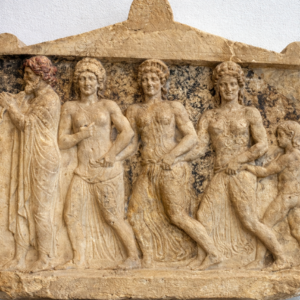
In classical Greek religion, charis was not merely an abstraction but a personified divine force, embodied in the Charites (Χάριτες), goddesses associated with beauty, pleasure, charm, fertility, and social cohesion. These figures operated within the orbit of false imagination or fallen beings, Olympian pagan deities such as Zeus and Aphrodite, functioning as agents of attraction and favor rather than moral instruction or covenant faithfulness. Their influence permeated Greek culture, where charis described that which delights, persuades, or binds through benefaction. Crucially, this favor was transactional—granted by a superior and sustained through loyalty, gratitude, and return honor. The recipient was indebted, not transformed. Thus, charis belonged to a worldview structured by patronage, not righteousness.

By contrast, the Hebrew Scriptures ground divine favor in the covenantal identity and moral character of יהוה (YHWH). The Hebrew term חֵן (ḥēn) signifies favor or grace, yet it never functions independently of obedience, justice, or relational fidelity. In Torah, favor follows election, and election precedes obedience, but obedience remains the covenantal expectation. Israel is redeemed from Egypt prior to receiving commandments (Exod. 20:1–2), establishing that obedience does not earn favor, yet favor never nullifies instruction. The Prophets reinforce this structure by announcing a renewed covenant in which Torah is written on the heart rather than discarded (Jer. 31:31–33; Ezek. 36:26–27). In this framework, divine favor empowers covenant faithfulness; it does not replace it.
The translation of Hebrew Scripture into Greek (the Septuagint) introduced charis as a functional approximation of ḥēn, but approximation is not equivalence. While linguistically serviceable, charis carried with it an inherited conceptual world foreign to Torah. Over time, especially as the movement surrounding Yeshua (יֵשׁוּעַ, Yēšûaʿ, “YHWH saves”) expanded into Gentile contexts, the Greek semantic field increasingly governed theological imagination. Favor began to be conceived less as covenantal empowerment and more as unconditional benefaction, detached from obedience and moral transformation. This shift was not demanded by the text itself but by the cultural logic embedded in the borrowed term.
The danger of this Hellenized redefinition becomes apparent when charis is abstracted from Torah and treated as a self-contained soteriological principle. Grace is reframed as permission rather than power, acceptance rather than alignment, and exemption rather than enablement. Such a model aligns far more closely with Greek patronage ideology—where favor is granted without expectation of shared moral life—than with Hebraic covenant theology. Yet Yeshua explicitly resists this dichotomy, affirming that love for Him is expressed through keeping His commandments and warning against annulling even the least of them (Matt. 5:17–19; John 14:15). The apostolic writings likewise insist that faith establishes Torah rather than abolishing it (Rom. 3:31), revealing that obedience functions as evidence of relationship, not its currency.
Thus, the issue is not the lexical use of charis per se, but the conceptual inheritance smuggled into theology when Greek categories are allowed to override Hebraic ones. Borrowed words carry borrowed assumptions. When those assumptions remain unexamined, they reshape doctrine in subtle but profound ways. Torah, as the revealed instruction of the Holy One, serves as the corrective lens, exposing foreign attributes and testing theological claims line upon line. It reveals who YHWH is—and by necessary contrast, who and what does not reflect Him. In this light, the Hellenized abstraction of grace stands exposed not as biblical fidelity, but as a displacement of covenant by culture, replacing instruction with indulgence and transformation with transaction.
Works Cited
Aristotle. Nicomachean Ethics. Translated by W. D. Ross, Oxford UP, 2009.
Bauer, Walter, et al. A Greek-English Lexicon of the New Testament and Other Early Christian Literature. 3rd ed., University of Chicago Press, 2000.
Briggs, Charles A., and Francis Brown. The Brown–Driver–Briggs Hebrew and English Lexicon. Hendrickson, 2003.
Jeremiah 31:31–33. Biblia Hebraica Stuttgartensia.
Ezekiel 36:26–27. Biblia Hebraica Stuttgartensia.
Exodus 20:1–17. Biblia Hebraica Stuttgartensia.
Hesiod. Theogony. Translated by Hugh G. Evelyn-White, Harvard UP, 1914.
Sanders, E. P. Paul and Palestinian Judaism. Fortress Press, 1977.
Septuagint. Rahlfs-Hanhart Edition. Deutsche Bibelgesellschaft.
Matthew 5:17–19; John 14:15; Romans 3:31. Greek New Testament. UBS5.
#Torah
#WordOfYah
#LineUponLine
#PRECEPTUPONPRECEPT
#MessianicFaith
#HebraicRoots
#CovenantTheology
#torahontheheart
#YeshuaTheMessiah
#GraceAndObedience
#CharisExposed
#Hellenization
#BiblicalWorldview
#ReturnToTorah
#scriptureinterpretsscripture